Beyond the Green: The Ultimate Guide to Maximizing Color with Annual Flowers
Do you remember the first time you walked past a garden so vibrant it actually forced you to stop walking? It wasn’t just the greenery that caught your eye. It was the riot of reds, the deep, calming blues, and the sunny yellows that seemed to hum with life. In a world that often feels gray, routine, or overly paved, a garden filled with annual flowers offers a daily reminder of resilience and joy.
This isn’t just about digging in the dirt. It is about painting with nature. Whether you have a sprawling backyard or a single balcony box, the fleeting but intense life of an annual is a promise: that for this season, beauty won’t just exist—it will explode.
If you are looking to transform a dull patch of earth into a head-turning display, you are in the right place. This guide covers everything you need to know about maximizing color with annual flowers, from the soil science to the artistic design principles that professional landscapers use.
Table of Contents
Understanding the Power of Annual Flowers
Before you head to the nursery, it helps to understand what you are actually buying. In the gardening world, plants generally fall into two main camps: annuals and perennials.
Perennials are the marathon runners. They pace themselves, coming back year after year, but often blooming for only a few weeks at a time. They save energy for their root systems to survive the winter.
Annual flowers, on the other hand, are the sprinters. Their entire life cycle—germination, growth, flowering, and seed production—happens in one single growing season. Because they know they have only a few months to live, they don’t hold anything back. They expend every ounce of energy they have on producing blooms.
This biological urgency is exactly why they are the superior choice for color. While a perennial might give you a nice show in June and then fade to green, annuals like petunias and zinnias will pump out color from late spring all the way until the first frost hits. If your goal is continuous, high-impact visual appeal, annuals are the heavy lifters you need in your landscape.
Mastering Color Theory in the Garden
You don’t need a degree in fine arts to design a beautiful garden, but knowing a few basics about the color wheel can save you from a chaotic, messy look. When you are standing in the garden center surrounded by thousands of options, it’s easy to grab one of everything. Resist that urge. Strategy creates impact.
Cool vs. Warm Tones
The temperature of the colors you choose changes the entire “mood” of your outdoor space.
- Warm Tones (Red, Orange, Yellow): These are the attention grabbers. Think of fire engines and the sun. Warm colors advance visually, meaning they look closer to you than they actually are. If you have a large, cavernous yard that feels empty, planting a bed of bright red Salvia or orange Marigolds in the back will make the space feel more intimate and cozy.
- Cool Tones (Blue, Purple, Green): These are the relaxers. They recede visually, making them perfect for small courtyards or cramped balconies. A border of blue Lobelia or purple Heliotrope creates depth, tricking the eye into thinking the garden boundary is further away than it is.
Designing with Color Schemes
Once you know the mood you want, pick a scheme to keep your planting tight and professional.
1. Monochromatic Harmony
This is the easiest way to look like a pro. Pick one color and buy plants in varying shades of it. Imagine a garden bed featuring deep magenta Petunias, soft pink Cosmos, and blush-colored Zinnias. It’s soothing to the eye and impossible to mess up.
2. Complementary Contrast
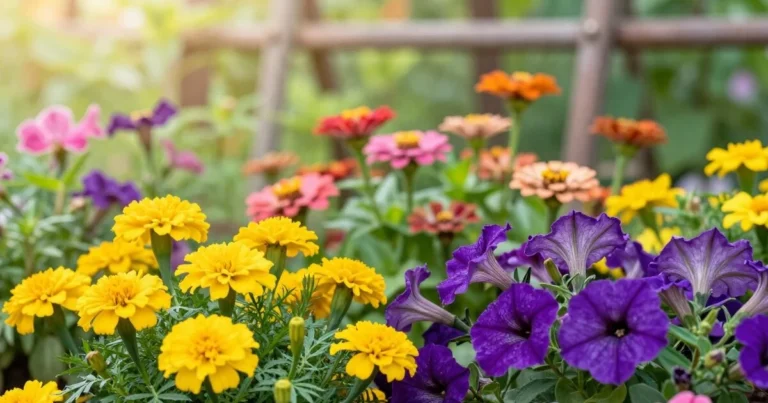
If you want drama, look across the color wheel. Purple and yellow are opposites, which is why they look so striking together. Pairing deep purple Petunias with bright yellow Marigolds makes both colors appear more intense than they would alone.
3. Analogous Flow
This involves choosing colors that sit next to each other on the wheel. Red, orange, and yellow are neighbors. Planting them together creates a sunset effect that feels natural and harmonious, rather than jarring.
Top High-Impact Annual Flowers for Season-Long Color
Not all annuals are created equal. Some fizzle out when the heat kicks in, while others just get started. Here are the reliable performers that give you the most “bang for your buck” when it comes to maximizing color.
Sun-Loving Annuals
If your garden gets 6 or more hours of direct sunlight, these are your go-to plants.
- Zinnias: These are arguably the easiest flowers to grow from seed. They come in almost every color except blue. The ‘Profusion’ series is particularly good for resisting disease and blooming continuously without needing much fuss.
- Marigolds: Often overlooked as “common,” marigolds are color powerhouses. Their saturated yellows and oranges are visible from down the street. Bonus: their scent repels many garden pests.
- Petunias: The classic choice for a reason. Modern varieties like ‘Supertnia’ or ‘Wave’ petunias are self-cleaning (meaning you don’t have to pick off dead flowers constantly) and spread massively, covering huge areas in ground-hugging color.
- Lantana: If you live in a hot, dry area, get Lantana. It thrives on neglect and produces clusters of multi-colored flowers that attract butterflies like magnets.
Shade-Loving Annuals
Got a dark corner under a tree? You don’t have to settle for just green ferns.
- Impatiens: Known as “Busy Lizzies,” these provide massive mounds of color in white, pink, red, and violet. They thrive where other plants fail.
- Begonias: These are double-duty plants. Wax begonias offer cute, durable flowers, but many varieties also have bronze or chocolate-colored leaves that add interest even when the flowers take a brief rest.
- Coleus: Okay, technically this is grown for its foliage, not its flower. But when the leaves are neon pink, lime green, and deep burgundy, who needs petals? Coleus adds structure and consistent color to shade beds that never fades.
Note: Always check your local hardiness zone. While these are annuals almost everywhere, your specific start and end dates for planting will vary based on your local frost dates.
The Recipe for Success: Essential Planting Ingredients
You cannot expect a marathon performance from a runner if you only feed them water. The same applies to your flowers. To get that magazine-cover look, you need to treat the soil as a living system.
Native soil is rarely enough for high-performance annuals. They are hungry plants. Here is the breakdown of what you need to add to your cart to ensure success.
Table 1: Essential Planting Ingredients for Annuals
| Ingredient Category | Recommended Product/Type | Purpose |
| Soil Amendment | Organic Compost or Peat Moss | Most garden soil is too heavy (clay) or too loose (sand). Compost fixes both. It improves drainage so roots don’t rot, but holds enough moisture to keep them hydrated. |
| Base Fertilizer | Slow-Release Granular (10-10-10) | Think of this as the “breakfast” for your plants. It provides a steady, low-dose feed of Nitrogen, Phosphorus, and Potassium over 3-4 months. |
| Bloom Booster | Water-Soluble High-Phosphorus Feed | This is the “energy drink.” Used mid-season, a high-phosphorus liquid feed shocks the plant into stopping leaf production and pushing out more flowers. |
| Mulch | Shredded Pine or Cedar Bark | Crucial for color retention. Hot roots lead to faded flowers. Mulch acts as insulation, keeping roots cool and cutting your watering chores in half. |
| Tools | Sharp Snips & A Good Trowel | You need a trowel with depth markers to plant at the right level, and sharp snips for clean cuts when deadheading (tearing stems invites disease). |
Design Techniques to Maximize Visual Impact
You have your plants and your soil. Now, how do you put them in the ground? Don’t just dig a hole and drop them in. Use these landscape architect tricks to make the colors pop.
The Drift Method
One of the biggest mistakes new gardeners make is the “polka dot” effect—planting one red flower, then one white one, then one pink one. From a distance, this looks messy and indistinguishable.
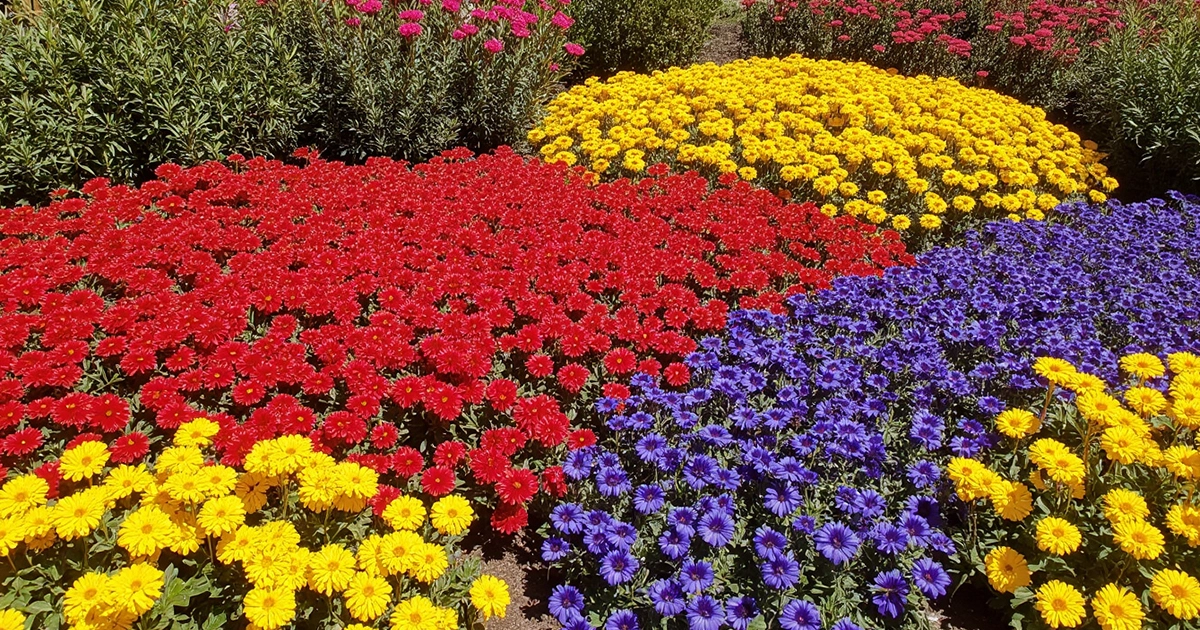
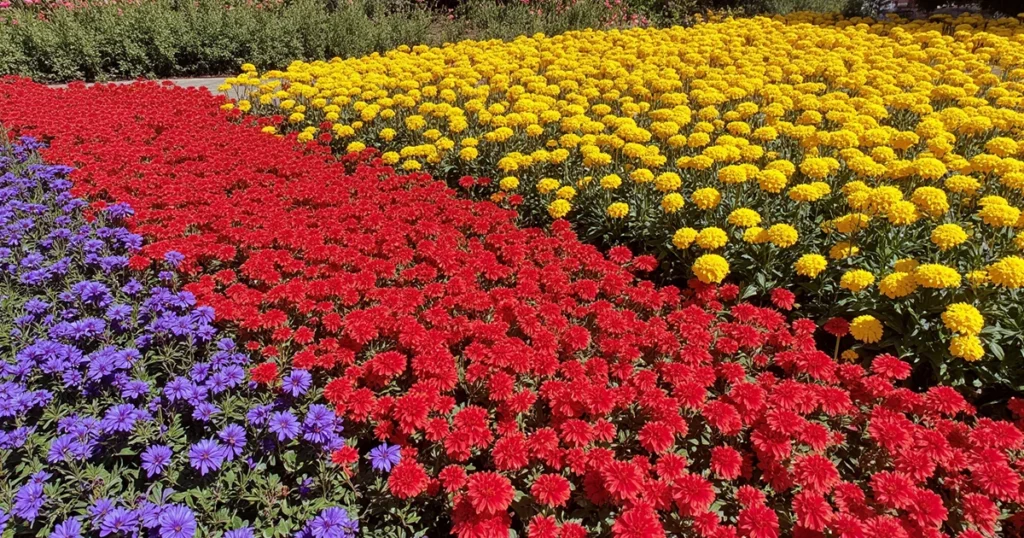
Instead, plant in drifts. A drift is an irregular, kidney-shaped clump of the same plant. Group 5, 7, or 9 red Zinnias together. Then, next to them, group 7 yellow Marigolds. This creates solid blocks of color that the eye can register from a distance. It looks intentional and bold.
Vertical Gardening with Annuals
If you have a small yard, you can still have huge color by going up. Use trellises, fences, or even shepherd’s hooks.
- Morning Glories: Fast climbers with trumpet-shaped blue or purple flowers.
- Black-Eyed Susan Vine: distinct orange or yellow flowers with a dark center that looks great climbing a mailbox post.
- Nasturtiums: These can climb or trail, offering edible flowers in sunset shades.
Container Combinations (The Thriller, Filler, Spiller Method)
If you are planting in pots, follow this golden rule for a professional look:
- Thriller: Put a tall, statement plant in the center or back. Dracaena spikes or a tall Canna Lily work well.
- Filler: Surround the thriller with mounded plants that hide the “legs” of the tall plant. Geraniums or Impatiens are great fillers.
- Spiller: On the edges, plant something that trails over the side. Sweet Potato Vine or Calibrachoa (Million Bells) soften the edges of the pot and extend the color downward.
Maintenance Secrets for Non-Stop Color
You planted them, and they look great. But two weeks later, they look tired. What happened? Annual flowers need active parenting. You can’t just set them and forget them if you want color until October.
Deadheading: The Fountain of Youth
This is the most critical task. An annual’s biological goal is to make seeds. Once a flower fades and forms a seed head, the plant thinks, “My job is done,” and stops blooming.
You have to trick it. By deadheading (pinching or cutting off the spent blooms before they form seeds), you send a signal to the plant that it failed to reproduce. Panic sets in, and the plant redoubles its efforts to produce more flowers. Regular deadheading can triple the number of blooms you get in a season.
Watering Wisely
Annuals generally have shallow root systems compared to shrubs or perennials. They dry out fast. However, how you water matters.
- Don’t sprinkle the leaves. Wet leaves in the sun can scorch, and wet leaves at night invite fungus like powdery mildew.
- Do water the soil directly at the base. A soaker hose is your best friend here.
Mid-Season Pruning
Around mid-July, many annuals get “leggy.” They have long, spindly stems with just a few flowers at the very tips. It looks scraggly.
Be brave. Take your shears and cut the plant back by about one-third. It will look terrible for a week. But you are forcing the plant to grow new, compact stems. By August, you will have a fresh, bushy plant covered in blooms while your neighbor’s plants are looking tired.
Frequently Asked Questions About Annual Flowers
Do annual flowers come back every year?
Technically, no. True annuals complete their life cycle in one season and die with the frost. However, nature finds a way. Some plants, like Cosmos or Cleome, are prolific self-seeders. They drop seeds into the soil before they die, and those seeds germinate the following spring, making it look like the plant came back. Additionally, in warmer climates (Zones 9-11), some plants we treat as annuals (like Begonias) act as perennials.
What is the longest-blooming annual flower?
If longevity is your goal, look at Wax Begonias, Zinnias, and Vinca. These are tireless. As long as you keep them watered and deadheaded, they will usually bloom from the moment you plant them in spring right up until the first hard freeze of autumn.
Can I plant annual flowers in the shade?
Absolutely. Shade does not mean a lack of color. While you won’t get the same variety as sun plants, varieties like Impatiens, Coleus, and Torenia (Wishbone Flower) thrive in low-light areas. In fact, planting white or light pastel annuals in a shady area effectively “lights up” the dark corners of a yard.
How often should I fertilize my annual flowers?
Because they grow at such a rapid pace, annuals are “heavy feeders.” The nutrients in the potting soil usually run out after about 4-6 weeks. It is best practice to mix a slow-release fertilizer into the soil at planting, and then supplement with a water-soluble liquid fertilizer every 2-3 weeks throughout the summer to keep the color intensity high.
Conclusion
Your garden is more than just landscaping; it is a canvas, and annual flowers are your most vibrant paints. They offer an opportunity to experiment, to change your mind, and to reinvent your outdoor space every single spring.
By understanding the basics of color theory, selecting the right varieties for your specific light conditions, and fueling them with the right soil ingredients, you can transform a plain patch of grass into a breathtaking sanctuary. Don’t be afraid to make mistakes. If a color combination doesn’t work this year, the beauty of annuals is that you get a blank slate next year.
So, use this season to be bold. Mix that orange and purple. Plant that neon pink drift. Let your garden reflect the joy and energy you want to see in the world.
Now, are you ready to get your hands dirty? Grab your trowel and head to the nursery—it’s time to plant.